Eight starting questions for a Physics investigation
Original seeds for measurements, models and published data, with a clear practical risk to test in a pilot.
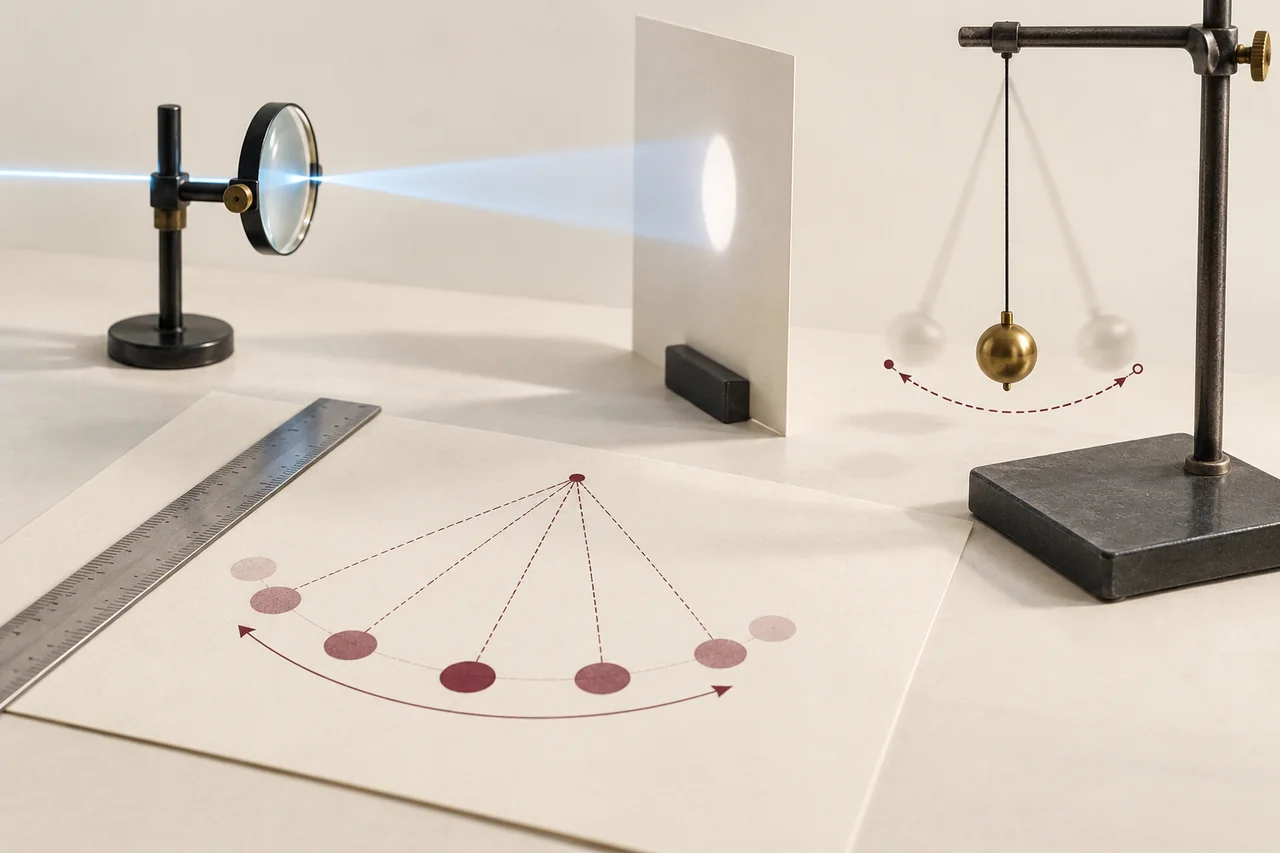
Choose an outcome you can measure
A Physics investigation needs a clear connection between the question, model and measurements. These original seeds are starting points that require adaptation and teacher approval. Check the school's equipment, safe operating arrangements and available collection time. Use ordinary school apparatus within approved limits; the examples do not provide experimental instructions.
Name the variable you will vary or compare and the physical quantity you will measure. Decide what the model predicts so you can select an informative range rather than collect arbitrary readings.
Mechanics investigations
- Pendulum amplitude: How does release amplitude relate to measured period for one fixed pendulum? Define amplitude and pilot whether timing precision can reveal the expected differences.
- Spring loading: How does extension relate to applied load within a teacher-approved range? Establish a consistent reference position and examine whether loading and unloading agree.
- A rolling ramp: How does ramp angle relate to the travel time of one rolling object over a fixed distance? Keep release conditions consistent and consider friction and rotation.
Energy, light and sound investigations
- Cooling and covering: How does one approved insulating layer affect a measured cooling curve? Match starting conditions and monitor the surroundings rather than assuming identical heat exchange.
- Light and distance: How does a sensor reading vary with distance from one suitable light source? Check background light, geometry and the sensor's operating range.
- Resonance and geometry: How does the length of an approved air-column setup relate to a measured resonance frequency? Define the endpoint method and use school-supported sound levels and apparatus.
Fields and published-data investigations
- A coil and magnetic response: How does a school-approved low-voltage circuit condition relate to an observable magnetic response in a fixed setup? Check alignment, background fields and safe operating limits with the teacher.
- Orbital data: How well do published orbital periods and orbital dimensions follow a stated model for a carefully selected system? Check parameter definitions, host properties and measurement uncertainties.
Pilot the measurement that limits the question
Shortlist two seeds and identify the weakest step. In the light-distance example, a pilot can show whether background light dominates at larger distances or the sensor saturates nearby. That information should guide the usable range. In the spring example, a pilot can reveal an unclear zero position or a response outside the intended regime.
Record the pilot conditions and unexpected observations. Repeats should help you understand variability; they do not repair an unsuitable range or a poorly defined measurement. Discuss realistic adjustments before full data collection.
Define the mathematical comparison
Write the relationship you expect, the variables' units and the graph or calculation that can test it. Explain any transformation and whether its assumptions apply to the setup. For database work, inspect actual records and documentation before committing; a published number can have a definition or uncertainty that changes its use.
Choose the question with a defensible route from raw observations to an answer. Bring the pilot and analysis plan to your teacher, confirm the course requirements and reserve time for collection, processing and evaluation within the school deadline.
Your next-step checklist
Checklist choices stay in this browser.
Official references
This is an original practical guide from IBvia. The examples are illustrative; your subject guide, assessment year and school instructions determine the requirements.
Keep working on your next step
Design a science IA you can actually carry out
Move from a research question to a safe pilot, usable data and a specific evaluation of your method.
Read the guide ↗
Eight starting questions for a Biology investigation
Original investigation seeds with measurable outcomes, manageable boundaries and practical checks before collecting data.
Read the guide ↗