Make a Physics IA graph support a physical conclusion
Choose meaningful axes, interpret gradient and intercept, and evaluate the fit using the actual measurements.
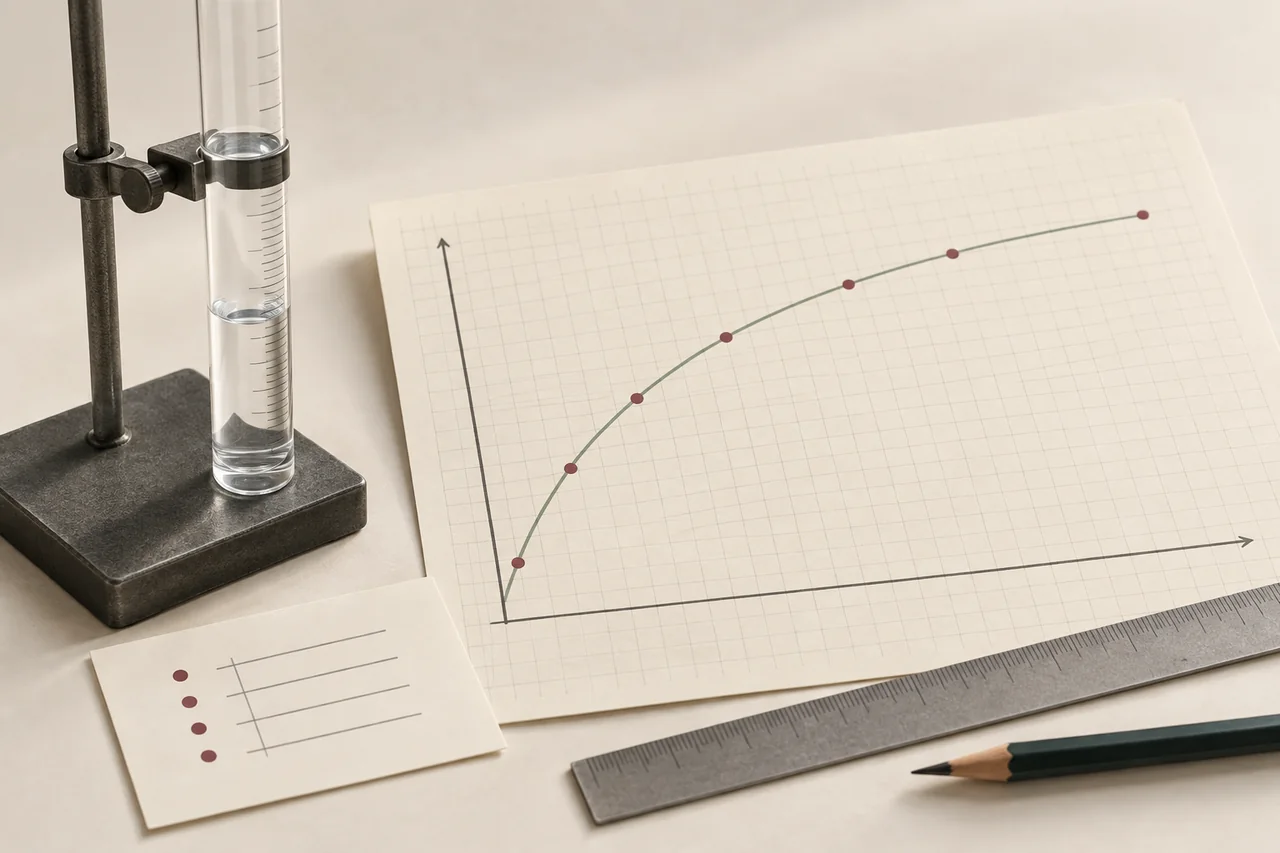
Choose axes from the physical relationship
Begin with the relationship you want to investigate. Decide which quantity belongs on each axis and whether a transformation will reveal the model more clearly. Explain the choice before presenting the graph. An attractive straight line has little value if the transformation removes the physical meaning or uses an unjustified assumption.
For an illustrative spring investigation, F = kx suggests plotting force F against extension x when the model applies. The gradient represents k. The choice of axes determines both the gradient's meaning and its units.
Prepare data without hiding decisions
Keep the original measurements and create a separate processed table. Include units, suitable precision and uncertainty information using the method agreed with your teacher. Show a representative calculation for transformed quantities. Document exclusions and corrections with evidence from the measurement record.
If a reading looks unusual, inspect the apparatus notes and source values. Removing it solely because it weakens the line can conceal a physical limitation. A genuine departure may show that the investigated range includes a different behavior.
Interpret gradient with units
For illustrative points x = 0.02 m, F = 0.50 N and x = 0.06 m, F = 1.50 N, the gradient between them is 1.00 N divided by 0.04 m, or 25 N/m. This demonstrates the calculation and units; your actual estimate should use an appropriate fit to the full relevant dataset.
Explain how the fitted gradient connects to the physical model. If you reverse the axes, the gradient represents a different quantity. Check that the value's magnitude and unit make sense before comparing it with any reference.
Inspect the intercept and remaining pattern
An intercept different from zero may reflect a reference offset, another physical contribution or uncertainty. Investigate the setup before assigning an explanation. Do not force a fit through the origin merely because the simplest equation has no constant term. State and justify any fitting constraint.
Inspect residuals or the distribution around the line. A curve may indicate that the model is unsuitable across the full range. Greater spread at one end may relate to measurement limitations. Connect the pattern to evidence from the procedure rather than listing generic errors.
Explain uncertainty in the fitted result
Use a gradient-uncertainty approach suitable for your data and course guidance, and explain what it represents. Graphical bounding lines and software estimates make different assumptions. If software supplies an uncertainty, identify the method and the input uncertainties it does or does not include.
- Label axes with quantities and units.
- Make the scale reveal the relevant data range.
- Define uncertainty bars when they are used.
- Show the fit and explain how its parameters were obtained.
Connect the graph to the question
State whether the measurements support the proposed relationship within the investigated conditions. Compare the parameter with a relevant model or reference and discuss meaningful disagreement. Suggest an improvement that targets the limitation shown by the data. Keep captions and prose specific: the reader should know which feature supports your conclusion and where that support becomes weaker.
Your next-step checklist
Checklist choices stay in this browser.
Official references
This is an original practical guide from IBvia. The examples are illustrative; your subject guide, assessment year and school instructions determine the requirements.
Keep working on your next step
Design a science IA you can actually carry out
Move from a research question to a safe pilot, usable data and a specific evaluation of your method.
Read the guide ↗
Eight starting questions for a Biology investigation
Original investigation seeds with measurable outcomes, manageable boundaries and practical checks before collecting data.
Read the guide ↗