Eight starting questions for a Chemistry investigation
Original question seeds for measurable chemical relationships, with pilots and controls to establish feasibility.
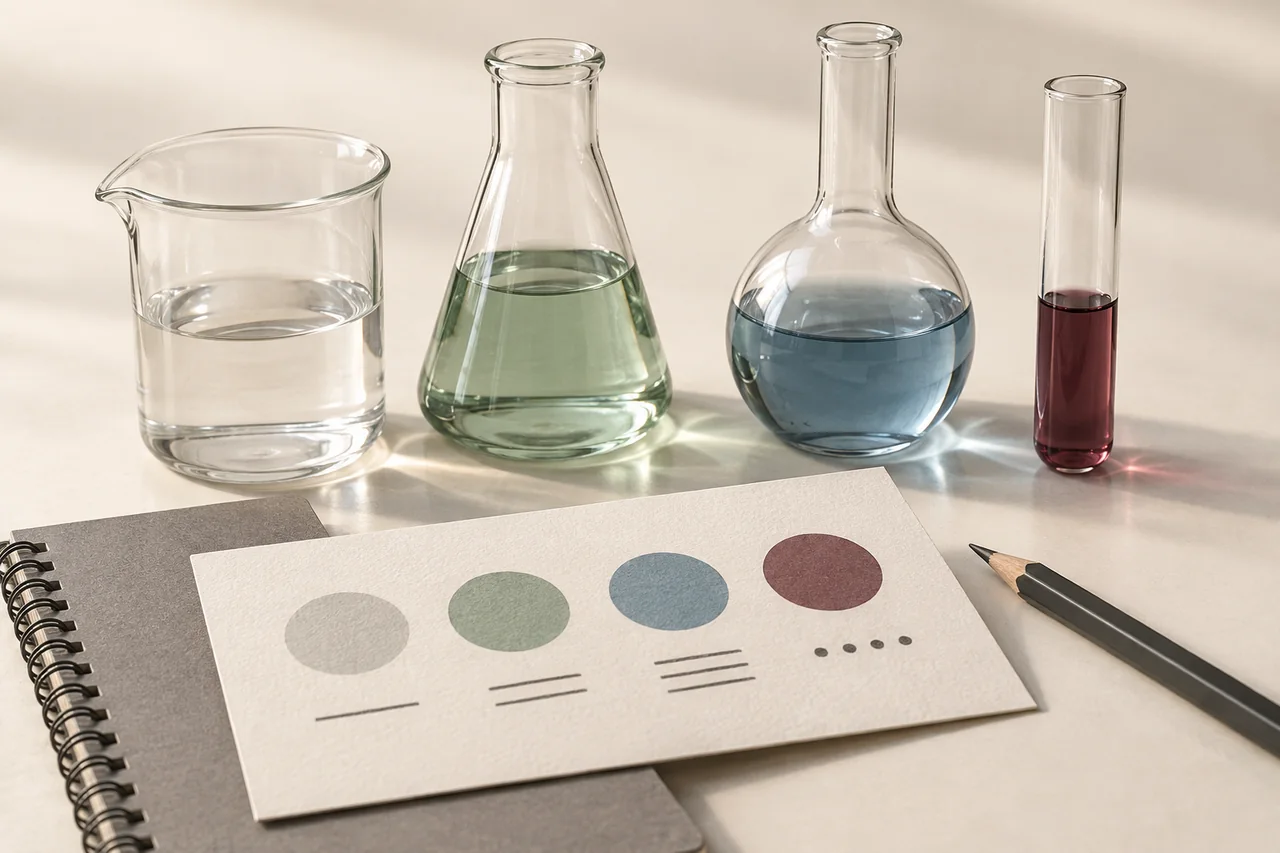
Choose a measurable chemical relationship
Begin with a chemical idea, a response you can measure and the equipment your school can provide. These original seeds require adaptation and teacher approval. Use the school's authorized chemicals, apparatus, handling and disposal arrangements. Avoid building a method around materials whose composition or hazards you do not understand.
A familiar substance can support substantial analysis if you define its composition and conditions. Decide whether your outcome measures an equilibrium property, a reaction rate or another quantity; those distinctions affect the procedure and interpretation.
Solution-property investigations
- Conductivity and concentration: How does concentration relate to conductivity for an approved electrolyte over a defined dilute range? Standardize temperature and check the sensor's usable range.
- Solubility and temperature: How does the equilibrium solubility of a suitable substance vary over teacher-approved temperatures? Distinguish complete equilibration from the speed of dissolving.
- Buffer dilution: How does dilution affect the measured response of an approved buffer system to a standardized addition? Define the response and check the instrument's resolution.
- Freezing behavior: How does an approved solute concentration relate to a measured freezing characteristic of a solution? Pilot whether supercooling and endpoint interpretation can be handled consistently.
Reaction and energy investigations
- Storage and oxidation: How does a defined storage condition relate to an assay result for a suitable classroom sample? Confirm the assay's selectivity and distinguish initial sample variation from storage effects.
- Calorimetry and concentration: How does an approved reactant concentration affect a measured temperature change in a school calorimetry method? Account for volume, mixing and heat exchange.
Published-data investigations
- Boiling points in a series: How does a defined structural feature relate to published boiling points within a carefully selected compound family? Check pressure, data provenance and comparability.
- Water chemistry over time: How does one reported dissolved-ion measure vary across a defined monitoring period at one site? Inspect sampling methods, units and changes in laboratory procedures.
Run a pilot for the difficult step
Shortlist two seeds and identify what is most likely to fail: an unclear endpoint, a weak signal, inconsistent sample preparation or inaccessible data. Test that step early with the teacher's approval. Record the pilot and explain how it changes your proposed range or method.
For conductivity, try a small set of solutions to see whether the readings distinguish your planned concentrations. If temperature drifts during the sequence, repeated readings may show variation unrelated to concentration. Decide how to monitor or stabilize that condition before collecting the main dataset.
Turn the seed into a focused question
Specify the substance or compound family, range, conditions and measured response. State the chemical rationale using appropriate sources and decide how raw measurements become your analytical result. Keep instrument information, units, uncertainty and observations with the original data.
Select the seed with a credible route to an answer within the school timeline. Ask your teacher whether the proposed methods and analysis suit your course. Topic choice starts the investigation; your own choices, calculations and evaluation determine how clearly the evidence answers the question.
Your next-step checklist
Checklist choices stay in this browser.
Official references
This is an original practical guide from IBvia. The examples are illustrative; your subject guide, assessment year and school instructions determine the requirements.
Keep working on your next step
Design a science IA you can actually carry out
Move from a research question to a safe pilot, usable data and a specific evaluation of your method.
Read the guide ↗
Eight starting questions for a Biology investigation
Original investigation seeds with measurable outcomes, manageable boundaries and practical checks before collecting data.
Read the guide ↗