Ten starting questions for a Mathematics AA exploration
Original question seeds for functions, calculus, sequences and geometry, with boundaries that make them workable.
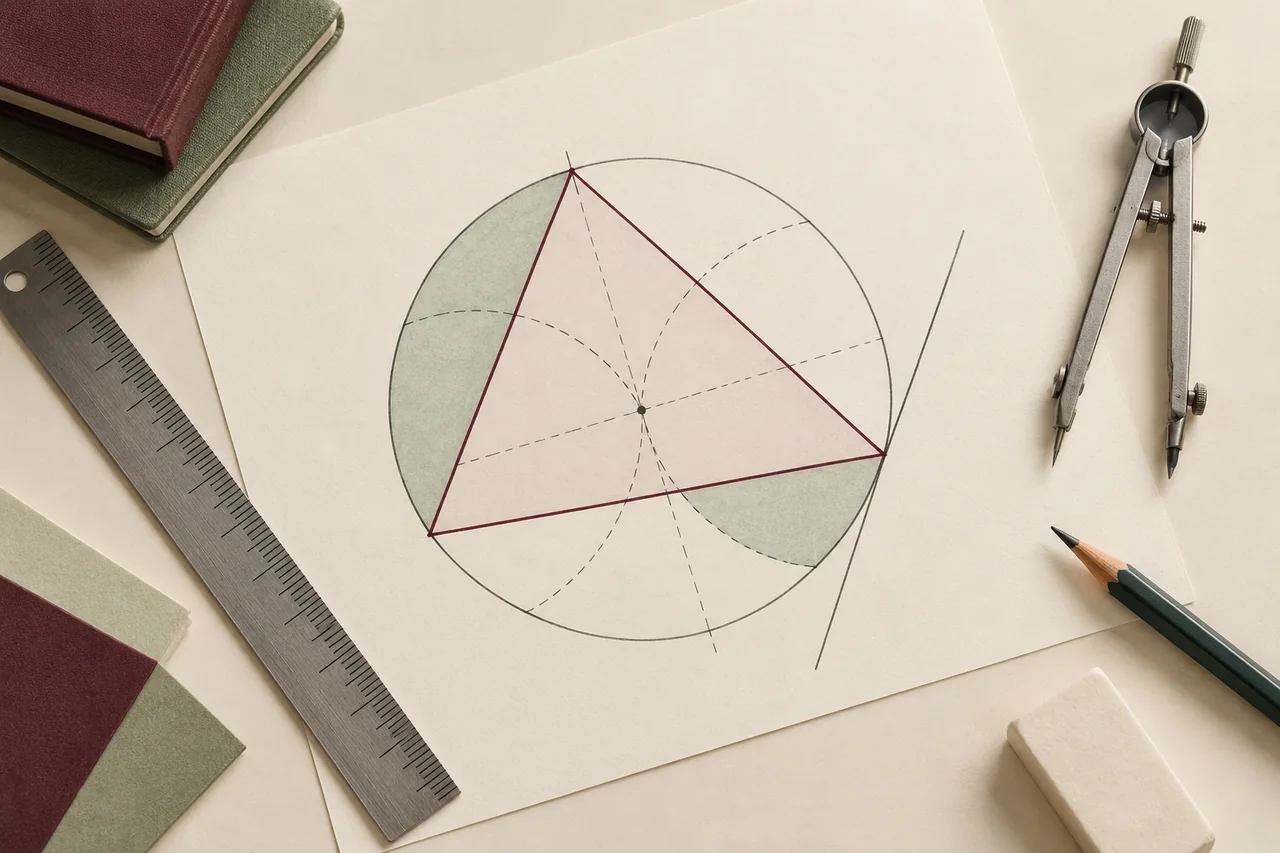
Start with mathematics you can develop
Choose a question because you want to understand its mathematics and can explain the techniques involved. These original seeds offer a starting direction; they are not approved IA titles or finished explorations. Check suitability for your course and level with your teacher. Define the quantities, constraints and useful result before spending time on presentation.
A simple initial model can lead to substantial reasoning when you test its assumptions or compare it with another approach. Adding advanced notation without understanding creates a weaker investigation.
Questions about functions and shape
- A smooth ramp transition: Which polynomial can join two specified heights and slopes? Define the endpoint conditions and examine whether the resulting gradient is practical.
- A measured arch: How well does a quadratic curve represent the profile of one accessible arch? Fit defined measurements and test predictions at additional locations.
- A rotating sign: How does viewing angle change the apparent width of a rectangular sign in an idealized model? Use a clear geometric diagram and examine the model's limits.
- A repeating temperature pattern: How well can a trigonometric function represent one room's recorded daily variation? Specify a consistent observation period and discuss deviations from periodicity.
Questions about optimization
- A folded tray: Which corner-cut size maximizes the volume of a tray made from a fixed rectangular sheet? Derive the domain and compare the mathematical optimum with a measured prototype.
- A parcel constraint: Which rectangular dimensions maximize volume under one stated length-and-girth restriction? Explain which dimensions vary and why the constraint represents the chosen case.
- A two-surface journey: Where should a walker cross a boundary between two surfaces to minimize travel time in a model? State speed assumptions and compare the optimum with alternative routes.
Questions about accumulation and comparison
- A changing tank profile: How does container shape affect water depth as a known volume is added? Model the cross-section and compare predicted depths with safe measurements.
- A decorative sequence: How do tile counts grow when a clearly defined pattern is extended? Derive a general expression and compare two construction rules with the same initial terms.
- An elliptical border: How accurate are two manageable perimeter approximations for a measured elliptical shape? Explain the methods, compare estimates and consider how measurement uncertainty affects the comparison.
Check the mathematical route
For two shortlisted seeds, write a provisional question, variables and first calculation. Identify a source for any technique you have not yet learned, then test whether you can explain it. Some extensions may suit HL better or require guidance; the list does not assign a level or promise suitability.
In the folded-tray seed, write the volume as a function of cut size and identify the physically possible interval before differentiating. That pilot immediately exposes whether you have understood the geometry and whether a stationary value lies in the domain.
Keep one focused investigation
Choose the seed with the clearest route to an answer and a useful opportunity for refinement. Record why you rejected or changed alternatives. Build your own examples and reasoning, acknowledge outside methods and discuss the proposal with your teacher. Your final question should be more precise than its starting seed and feasible within the school's project timeline.
Your next-step checklist
Checklist choices stay in this browser.
Official references
This is an original practical guide from IBvia. The examples are illustrative; your subject guide, assessment year and school instructions determine the requirements.
Keep working on your next step
Shape a useful Mathematics AA exploration question
Turn an interest into a focused question with a clear quantity, mathematical method and manageable test.
Read the guide ↗
Plan a Mathematics AI regression investigation
Build a defensible dataset, inspect residuals and interpret a fitted relationship without overstating it.
Read the guide ↗