Build ESS case studies you can use in an argument
Turn case-study notes into evidence for systems, perspectives and sustainability, then practise adapting them to a question.
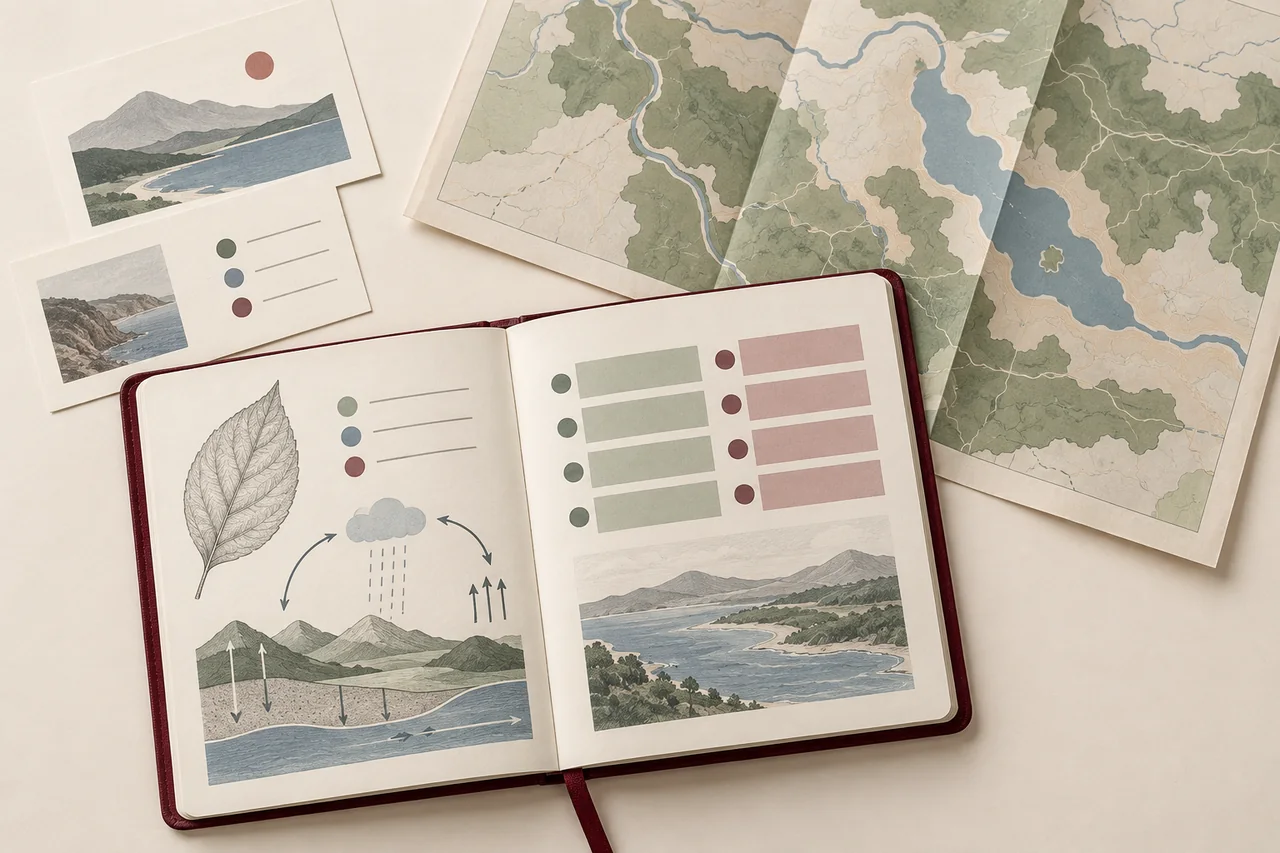
Give each case study a purpose
Choose a case because it helps explain an environmental process, evaluate a strategy or compare perspectives. Record the issue, location, period and why it belongs in your revision. An impressive collection of facts is difficult to use when you have not identified which argument those facts support.
Use sources that let you verify the relevant context and evidence. Record dates because conditions and outcomes can change. Follow your teacher's guidance on the examples and content appropriate to your course and level.
Make a compact evidence card
Create a card with the issue, system components, proposed or implemented strategy, useful evidence, stakeholder perspectives and a limitation. Keep numerical claims attached to their units, dates and source. A later report should not silently become evidence for the conditions of an earlier period.
For an illustrative river-restoration case, the system card might identify water quality, habitat, local land use and human activity. A strategy could involve changing runoff management. Your actual card needs verified evidence about what was done and what changed.
Explain a causal pathway
Choose one relationship in the system and explain how a change could move through it. Distinguish an established pathway from a possible effect. For runoff management, ask which material or water flow is affected, how that influences the receiving system and what evidence measures the outcome.
Include feedback or interactions where relevant, but explain them rather than drawing arrows without a mechanism. A useful system diagram makes your reasoning clearer and exposes an assumption that an essay may need to evaluate.
Compare perspectives using evidence
Identify the relevant stakeholder or worldview and the reasons behind its position. A community may value accessible land, while an environmental group may prioritize habitat protection. These are illustrative possibilities; research the actual case before assigning views. Explain where interests align or create tension.
Judge a strategy using criteria suited to the question, such as environmental effect, feasibility or distribution of costs and benefits. For HL, integrate the relevant course lenses where the question and guidance require them. A case should support analysis rather than function as a name added to a generic claim.
Practise retrieval and adaptation
Close the notes and reconstruct the case using a blank evidence card. Check missing details against the sources. Then use the case in a short answer to a fresh question. Decide which facts are relevant before writing; you do not need to reproduce the whole card.
- Practise one causal explanation and one evaluated judgment.
- Compare the case with another on a stated basis.
- Keep evidence and uncertainty together.
- Update a card when an important fact or source changes.
Handle unfamiliar exam resources separately
The current ESS assessment includes analysis of an unseen case study. Practise reading provided graphs, tables and text as evidence in their own right. Your familiar cases can help you recognize concepts, but they should not replace the data supplied by the question. Review any mistake as a reading, content or reasoning problem, then select a fresh practice task that targets it.
Your next-step checklist
Checklist choices stay in this browser.
Official references
This is an original practical guide from IBvia. The examples are illustrative; your subject guide, assessment year and school instructions determine the requirements.
Keep working on your next step
Read Biology data questions before reaching for memorized answers
Use axes, controls and specific evidence to build clear answers to unfamiliar biological data.
Read the guide ↗
Use science command terms to shape your answer
Identify the kind of response requested and connect it to the question's evidence, marks and scientific context.
Read the guide ↗