See the thinking
behind the writing.
Read an original teaching example, then explore 27 independent breakdowns of selected Extended Essays across nine subjects, with original assessment material where available.


Download the 27 selected EE essays ↓
27 EE guides
No guide matches that search. Try a broader subject or topic.
Browse the full PDF library · 1,205 files ↗
Mathematics

Predicting patterns from a step-and-turn drawing rule
A student-created drawing system becomes a mathematical investigation through conjecture, modular angles, classification and proof.
Read the breakdown ↗
Finding the curve of fastest descent
A numerical exploration of the brachistochrone problem begins with straight segments, then uses calculus to compare candidate curves. The essay develops a cycloid solution and connects its computational findings to Bernoulli's argument, showing why convincing numerical evidence still needs a mathematical justification beyond tested examples.
Read the breakdown ↗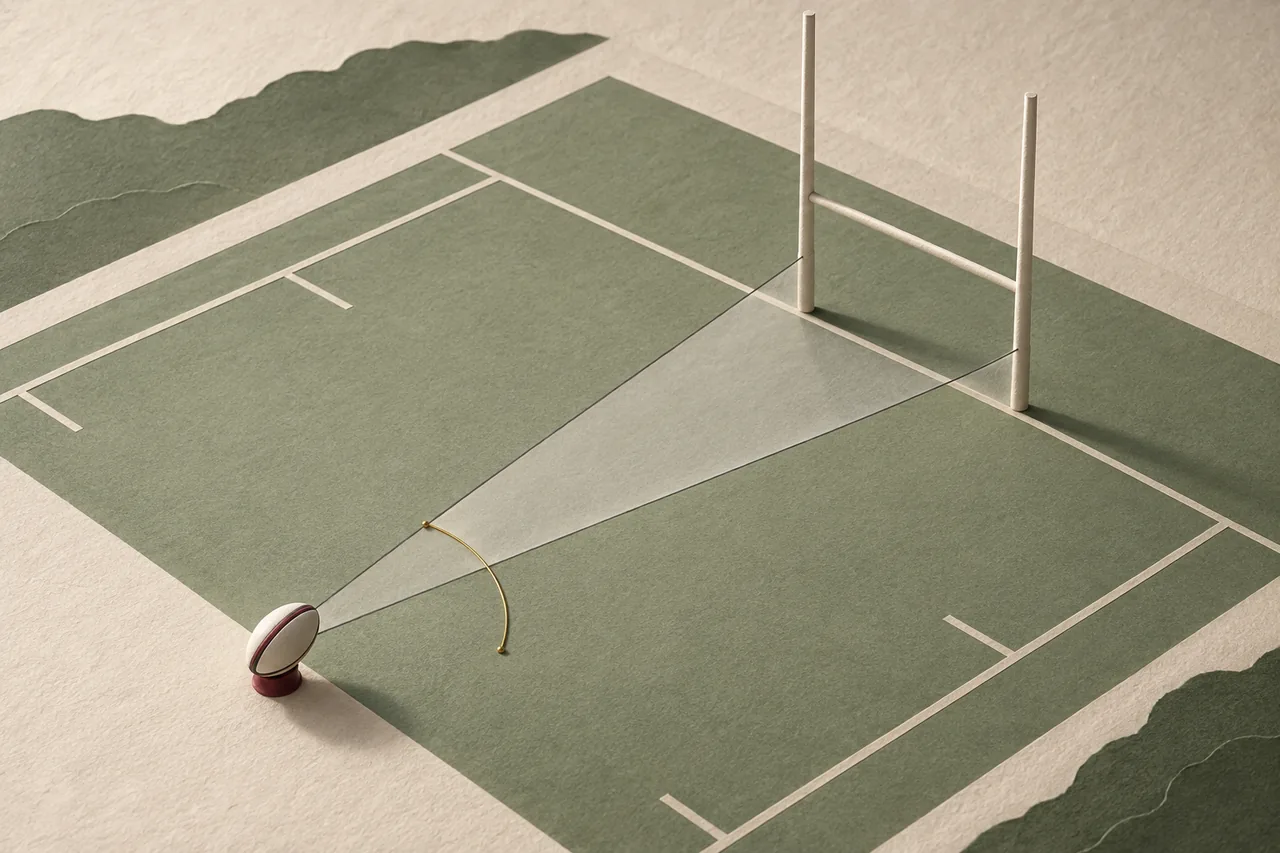
Optimizing the position of a rugby conversion kick
This essay models where a rugby conversion should be taken to maximize the angle between the goalposts. Trigonometric calculus and circle geometry produce matching results, before the model considers the crossbar, practical approximations and limitations arising from ball flight, player accuracy and changing weather conditions.
Read the breakdown ↗Sciences

Testing how insecticides affect waterweed and photosynthesis
A controlled experiment compares plant appearance, chlorophyll content and photosynthetic electron transport across three horticultural insecticides.
Read the breakdown ↗
Investigating UV exposure, stabilizer and chlorine decay
A two-factor experiment examines how ultraviolet light and cyanuric-acid stabilizer change hypochlorite decay in pool water.
Read the breakdown ↗
Estimating cosmic expansion from galaxy data
Galaxy images and spectra are used to estimate the Hubble parameter and cosmic age, followed by a discussion of model assumptions and uncertainty.
Read the breakdown ↗
Measuring how bow draw length changes energy-transfer efficiency
A recurve bow provides a practical test of energy transfer beyond a simple spring model. The investigation combines force measurements, integration and video analysis of arrow motion to estimate efficiency at different draw lengths, then evaluates measurement uncertainty, release technique and limitations in interpreting results.
Read the breakdown ↗
Balancing height and spacing in a street-lighting model
A scaled street-lighting model tests how lamp height affects average illuminance and its uniformity across a road. Measurements at nine positions are compared with physical models and historical design criteria, leading to a proposed spacing ratio and a careful discussion of extrapolation and experimental limitations.
Read the breakdown ↗
Reducing reagent excess in the synthesis of vanillyl alcohol
This investigation compares five amounts of sodium borohydride in the reduction of vanillin to vanillyl alcohol. Chromatography tracks conversion, while yield and product checks inform a green chemistry compromise. The evaluation distinguishes reaction completion from recovered product and identifies limits in timing, replication and measurement.
Read the breakdown ↗
Comparing how chloride salts change silver nanoparticle aggregation
The essay investigates how four chloride salts and their concentrations affect silver nanoparticle aggregation. Absorbance measurements track changes over time and support comparisons between salts. A mathematical calibration estimates particle size, while the evaluation explains how instrument resolution, sedimentation and large uncertainties constrain the conclusions.
Read the breakdown ↗
How do light, temperature and pH change dragonfly nymph activity?
A controlled investigation measures dragonfly nymph movement under different light, temperature and pH conditions. Three behavioural measures, graphical comparisons and significance tests turn observations into an argument. Its strongest teaching feature is the distinction between suggestive patterns, statistically supported differences and conclusions limited by sampling.
Read the breakdown ↗
Does woodlouse body length predict alternate turning in a maze?
A maze experiment investigates whether larger woodlice alternate turns more frequently. Preliminary studies establish the behaviour and compare two species before the main size investigation. The paper connects a null correlation to competing explanations, offering useful lessons about replication, biological mechanisms, sampling limits and interpretation.
Read the breakdown ↗Individuals and societies

Evaluating policy responses to excessive spirits consumption
The paper considers how effectively public information, taxation and regulation reduced overconsumption of spirits in Singapore.
Read the breakdown ↗
Assessing an international expansion decision
A focused decision question asks whether an agricultural organization should enter a new overseas market.
Read the breakdown ↗
Comparing causes of the Battle of Britain outcome
The investigation weighs British strengths against German mistakes to explain the battle’s outcome without turning into a narrative chronology.
Read the breakdown ↗
Using psychological research to examine bilingual education
The essay compares programme design, community support, socioeconomic context and funding in Indigenous Australian and international education settings.
Read the breakdown ↗
Could falling incomes create welfare gains in Bexley?
This local study asks whether lower incomes can create welfare gains through changes in tobacco, alcohol and leisure consumption. Surveys and interviews are compared with national evidence and externality diagrams. The argument is useful for studying conflicting evidence, local context and the limits of attribution.
Read the breakdown ↗
How much might a 10% saturated-fat tax reduce British healthcare costs?
A policy model follows a proposed tax from prices through consumption to healthcare spending. The essay combines published elasticities, research interviews and a small questionnaire, then calculates a conditional range of outcomes. Its value lies in exposing assumptions, distributional effects and uncertainty across each stage.
Read the breakdown ↗
Would a Qantas–British Airways merger offer more than their alliance?
A historical strategy study compares a proposed airline merger with an existing alliance. Industry research, company profiles and two force-field analyses explain why the balance of advantages might change. It demonstrates focused strategic comparison while revealing the risks of subjective weighting and unquantified benefits throughout.
Read the breakdown ↗
Should IKEA Sweden retain its forestry commitments during a recession?
This strategic decision study weighs forestry responsibility against cost pressure at IKEA Sweden. Secondary research, company information, PEST analysis and stakeholder mapping build a recommendation that distinguishes immediate savings from longer-term risks. It is particularly useful for studying focused scope, conflicting interests and evidence gaps.
Read the breakdown ↗
Measuring the success of Operation Linebacker II
An investigation of the December 1972 bombing campaign weighs American political and military objectives against its immediate outcomes. Comparing competing accounts, negotiations and eyewitness testimony, the essay distinguishes securing a settlement from achieving lasting strategic success, making the definition of success central to its historical argument.
Read the breakdown ↗
Explaining the rescue of Danish Jews in 1943
This essay investigates the Danish population's contribution to the rescue of Danish Jews in 1943. It weighs civilian networks, warnings and decisions by German officials, and Swedish assistance, using testimony and historical accounts to distinguish public willingness to help from the conditions that made escape possible.
Read the breakdown ↗
Choosing a motivational climate for athletes
A literature-based investigation compares task-oriented and ego-oriented coaching climates through achievement goal theory and self-determination theory. It considers motivation, anxiety, competence and performance, then qualifies its conclusions through athlete differences and social context, showing why a coaching recommendation needs more precision than a simple preference for one climate.
Read the breakdown ↗
Emotional intelligence and workplace performance
This investigation evaluates whether emotional intelligence improves workplace performance by comparing definitions, assessment methods and occupational studies. Its most useful methodological thread concerns the gap between association and improvement: measurement problems, alternative explanations and reverse causality complicate claims that emotional intelligence itself produces better results at work.
Read the breakdown ↗Studies in language and literature

Comparing Shakespeare’s construction of France
Three Shakespearean characters are compared through one interpretive lens: how early-modern English attitudes toward France shape their representation.
Read the breakdown ↗
Challenging Victorian perceptions of women
A comparative reading of The Tenant of Wildfell Hall and The Woman in White examines narrative structure, animal imagery and property. The essay links close analysis to Victorian expectations, exploring how female voices and material independence challenge convention while narrative framing and unresolved tensions complicate claims of liberation.
Read the breakdown ↗
Comparing language in old-school and new-school rap
An English A language investigation compares selected rap lyrics from different periods through address, slang, allusion and rhetorical effects. Close readings trace shifts in the chosen songs' presentation of community, gender and self-promotion, providing a useful example of language analysis alongside a clear need to limit genre-wide conclusions.
Read the breakdown ↗